Traveling Mercies
Since the religious sisters were receptive to the call of mercy, they were used to traveling in its direction, no matter how distant the particular need might be. And so, in accordance with their vows of poverty and obedience, the Sister-Nurses picked up the few possessions they had and went willingly whether they were ordered or implored. For the Mercy Sisters saw themselves as the hands and feet of Christ, and by serving “the least of these,” they lived out their vocation to feed and to comfort, to teach and to clothe. Drawn to the margins of the world, the Sisters of Mercy were not concerned about race or religion or whose side of the war one was on; rather, they were compelled to nurse whoever was injured with great love.
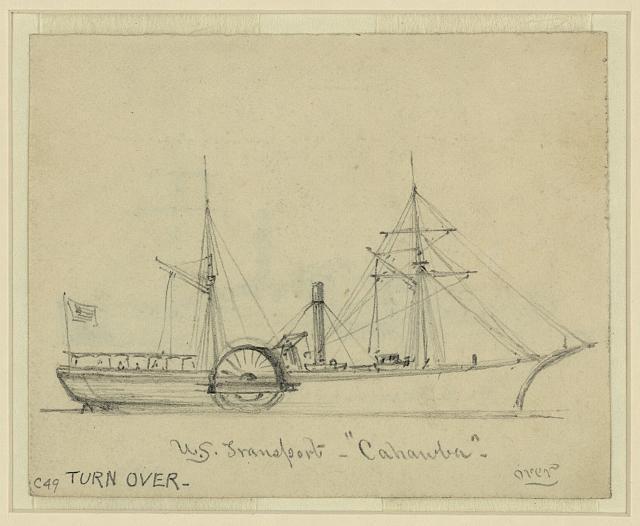
Depending on where they were heading, the Mercy Sisters traveled by boat or rail to their new destination. When Natchez Bishop William H. Elder sent for a band of women from the Baltimore community, the religious sisters embarked by train on October 9, 1860, journeying night and day until they arrived in Vicksburg, MS.[5] Other Sister-Nurses like the New York City community, who were headed to the coastal town of Beaufort, NC, encountered difficulties on their maritime expedition. While the Cahawba steamship, as pictured in Figure 1, was expected to leave New York harbor on July 15, 1862, the religious sisters’ departure was met with delays. Not only did the U.S. transport carry “500 horses detailed for war service,” whose boarding was laborious but the “steamer ran aground and was stalled for a night.” Nevertheless, this unfortunate series of events did not deter the Sisters of Mercy, and in due course, they reached Beaufort via a steam tug on July 19, 1862.[6]
Despite the lengthy time it took for the Mercy Sisters to land or the challenges they braved on their voyage south, in the face of war, the nurses were welcomed in their new homes. Although Catholics made up roughly twenty percent of the northern population in the 1860s, priests and women religious communities had endured anti-Catholic hostility prior to the Civil War.[7] Given the verbal and physical harassment that they suffered, some sisters were afraid to wear their habits while traveling or when walking in public. However, as trained nurses, the religious sisters provided a necessary service that few women embraced and, in binding the wounds of any soldier, they “evangelized by their example.”[8]
[5] Oakes, p. 14.
[6] Herron, Mary Eulalia. “Work of the Sisters of Mercy in the United States, Diocese of New York, 1846-1921.” p. 226.
[7] Shepherd, William J. "The Archivist’s Nook: Civil War Catholics – Patriotism on Trial.” Catholic University Libraries. 3 Jul. 2018, https://www.lib.cua.edu/wordpress/newsevents/tag/nuns-of-the-battlefield/. Accessed 26 Mar. 2021.
[8] McNamara, Patrick. "The Nuns of the American Civil War.” Aleteia. 3 Sep. 2017, https://aleteia.org/2017/09/03/the-nuns-of-the-american-civil-war/. Accessed 22 Apr. 2021.