Conclusion
In their compassionate service as nurses, the Sisters of Mercy helped countless numbers of soldiers in Washington, D.C., and at least two Southeastern cities during the Civil War. Although the focus of this exhibit is on the nursing contributions of the New York, Baltimore, Pittsburgh, and Vicksburg communities, the Mercy Sisters played a significant role in other parts of the United States as well. Regardless of if the wounded they tended to were Union or Confederate, Catholic or Protestant, black or white, the religious sisters were consistent in the soldiers’ care. For it was not up to these “angels of mercy” to turn away or to judge. Like their good Shepherd before them who went searching for the lost sheep, the Sister-Nurses of Catherine McAuley’s order were comparable to other women religious communities across the nation who fought tirelessly to protect the lives of all ages, faiths, and genders.
Whether it was the unidentified writing to President Lincoln to “increase the month’s allotment of rations” at Stanton Hospital as previous requests to the Secretary of War had been denied[13] or Mother Mary Madeline Tobin’s dispatching a list of needed supplies for Hammond Hospital to General Foster,[14] the Mercy Sisters were not ones to take “no” for an answer, especially when it came to saving lives. Interestingly enough, both the Pittsburgh sisters’ appeal from Washington and the New York sister’s entreaty from Beaufort were taken seriously. As a result, the former learned that Lincoln had approved their solicitation for aid and ordered the War Department to purchase “such provisions as they[Sisters of Mercy] desire”[15] while the latter received a steamer of “wash tubs, brooms, scrubbing brushes, lamps, kerosene, dishes, soaps, and drug-room supply.”[16]
Unfortunately, the Mississippi sisters did not have the support of the U.S. government since they were nursing Confederate soldiers. Therefore, when Vicksburg was initially attacked by Northern boats beginning May 19, 1862 through July 24, 1862, the Mercy Sisters underwent considerable hardship, as they turned their school into a hospital and ministered to the sick and wounded in the city.[17] Eventually, to escape the Union army, the sisters and their patients were forced to relocate and set up hospitals in Mississippi Springs, Oxford, Jackson, and Shelby Springs, Alabama. Due to the “lack of staff, food, equipment, and medical supplies,” many of the Southern soldiers died from measles and typhoid fever in addition to malaria, pneumonia, and dysentery. And yet, none of these infectious diseases stopped the Sister-Nurses from persistently carrying out their works of mercy in the early 1860s.
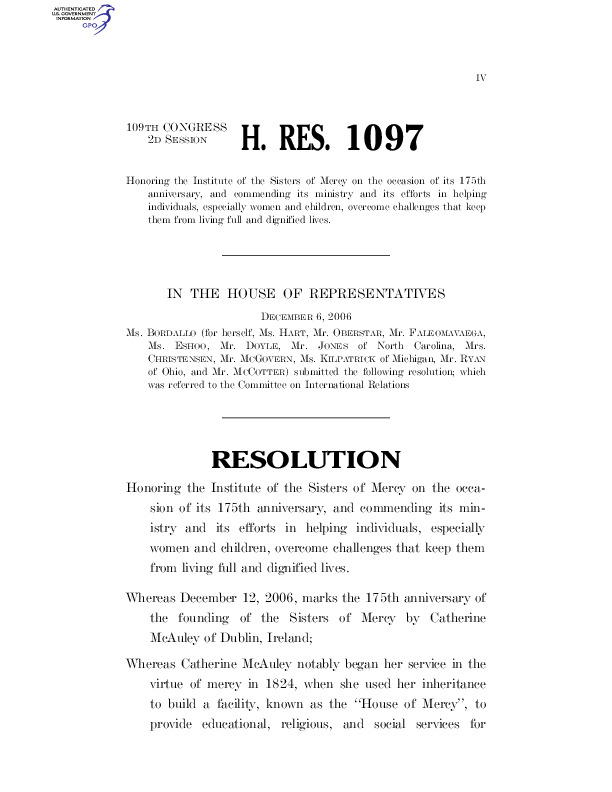
Even now, 160 years later, the Sisters of Mercy display a lifelong commitment to assist the poor, sick, and uneducated, but while their order’s birth is rooted in Ireland, their legacy of mercy grew stronger because of their Civil War service as Sister-Nurses. Despite being clustered in geographic communities throughout the country and caring for the injured and dying on both sides of the battlefield, the Mercy Sisters shared a common cause and an unconditional love for humanity that few could replicate. And though they have been honored on the commemorative “Nuns of the Battlefield” monument in Washington, D.C. and through legislation such as House Resolution 1097, viewable in Figure 5, the Sisters of Mercy are still worthy of recognition for the selfless spiritual, physical, and emotional care they have given in the past and present, for truly, their “dedication and compassion have transcended borders and improved and inspired the lives of others in need” through unfailing advocacy for others and the alleviation of suffering.
[13] Eulalia, Mary. “The Work of the Sisters of Mercy in the United States Pittsburg: 1843 to 1921.” p. 166.
[14] Herron, Mary Eulalia. “Work of the Sisters of Mercy in the United States, Diocese of New York, 1846-1921.” p. 227.
[15] Eulalia, Mary. “The Work of the Sisters of Mercy in the United States Pittsburg: 1843 to 1921.” p. 167.
[16] Oakes, pp. 16-17.
[17] Civil War Sisters https://civilwarsisters.com/grid-page/sisters-in-the-south/. 23 Mar. 2021, p. 2.