Holy Cross Sisters
After the Daughters of Charity, the Sisters of the Holy Cross made up the second-largest community of women religious whose services were called on in the Civil War.[8] Even though the Sisters of Charity had a total of 84 religious nurses when adding up the members of their three communities, the Holy Cross Sisters, headquartered in Notre Dame, IN, contributed at least 65 Sister-Nurses to the war effort. Since their order had been established in 1843 with a focus on teaching, the Sisters of the Holy Cross had no prior medical experience; however, the women who volunteered were ready to learn, and adjusted to the nursing responsibilities that lay ahead.[9]
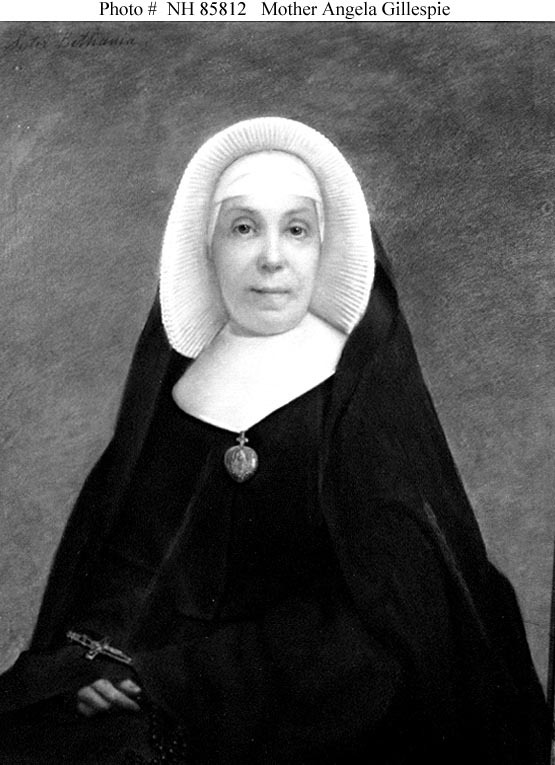
While under the leadership of Mother Mary Angela Gillespie whose portrait appears in Figure 4, the Holy Cross Sisters were given their first Civil War assignment. In October of 1861, the Governor of Indiana, Oliver P. Morton asked for the congregation’s help on behalf of the sick and wounded Indiana soldiers in Paducah, KY. Despite their lack of training, Mother Angela and 6 other sisters were undoubtedly moved by the request, and so, open to the journey, started on their nursing path that year.[10] In due time, Dr. John Brinton, Medical Director of Mound City Hospital, also invited the Holy Cross Sisters to staff his Illinois hospital. Brinton was vocal against the employment of lay nurses due to their “troublesome presence” and eventually replaced them with Sisters of the Holy Cross. According to Brinton, the religious sisters were better nurses, and the sick men “improved under the sisters’ care”.[11]
Perhaps due to a construed favoritism by Civil War doctors and other men in positions of power, but there was visible resentment from Dorothea Dix and the non-religious nurses who complained that the “Sisters” received preferential treatment in the hospitals. Historians have noted that Dix even discriminated against lay Catholic nurses[12] and criticized the sisters’ habit when she observed the Holy Cross Sisters at work in St. Aloysius Hospital in Washington, DC. As quoted by her contemporary, Mrs. Pomerory, the staunchly anti-Catholic Dix remarked “What looking objects to wait upon our sick and dying boys!”[13]
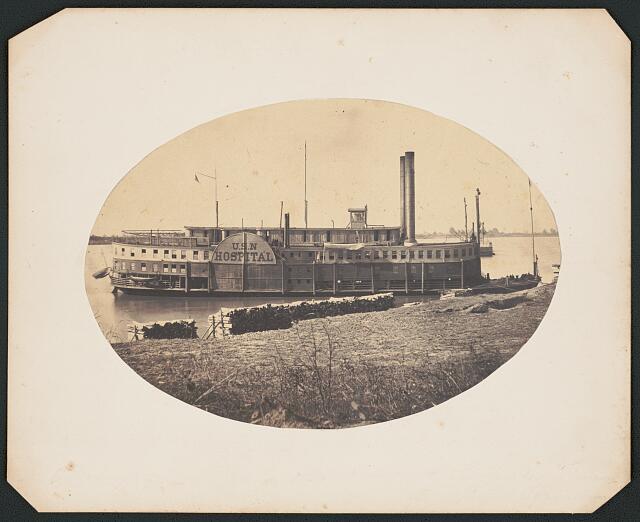
In the face of this negative attitude, the religious sisters were committed to their nursing duties, and through reliance on prayer, were unphased by the envy that the lay nurses held toward them. Therefore, when the Holy Cross Sisters were again approached by Gov. Morton to serve aboard the U.S.S. Red Rover, a former Confederate steamer ship, as photographed in Figure 5, they also achieved a famous first as the first female naval nurses in 1862.[14] By nursing alongside African American women, the Sisters of the Holy Cross were honored for their patriotism with a historical marker on the map below.[15]
[8] Maher, p. 69.
[9] "The Journey Continues: A History of the Sisters of the Holy Cross.” Sisters of the Holy Cross. https://www.cscsisters.org/wp-content/uploads/2019-The-Journey-Continues-web.pdf. Accessed 27 Apr. 2021, p. 2.
[10] "The Journey Continues: A History of the Sisters of the Holy Cross,” p. 4.
[11] Maher, p. 126.
[12] Maher, p. 128.
[13] Maher, p. 130.
[14] "USS Red Rover Hospital Ship.” Learning Lincoln On-line. http://www.learningabe.info/Uss_Red_Rover_HospitalShip_info.htm. Accessed 25 Apr. 2021.
[15] Maher, p. 102.