Conclusion
By documenting the details as to where the Sister-Nurses traveled and to whom they ministered in the 1860s, this exhibit has sought to portray the admirable character of the women religious. Even though the vast majority of the religious sisters were immigrants and had been born in Ireland, a growing number of their novices were raised in the United States or had come from other countries in Europe. Some ladies, in the manner of American saint and Sister of Charity Elizabeth Ann Seton, had converted to Catholicism, after undergoing a spiritual rebirth or witnessing the compassionate deeds of Catholic friends, but most members of the female orders had been brought up Catholic. In abiding by the Gospel values of their Christian faith, the Sisters of Charity, the Daughters of Charity, and the Sisters of the Cross did not merely outstretch their hands in mercy out of the goodness of their hearts; rather, they likened each charitable act to seeing the face of Christ in each person they served. When delivering the eulogy for Sister Anthony O’Connell in 1897, Bishop Thomas Byrne of Nashville, TN reminded mourners that “Christ was her inspiration, and for this reason, she trod the battlefield and entered hospitals pregnant with pestilence.”[16] While specifically describing a Sister of Charity, this type of statement explains the motivational “why” for other women religious communities, too.
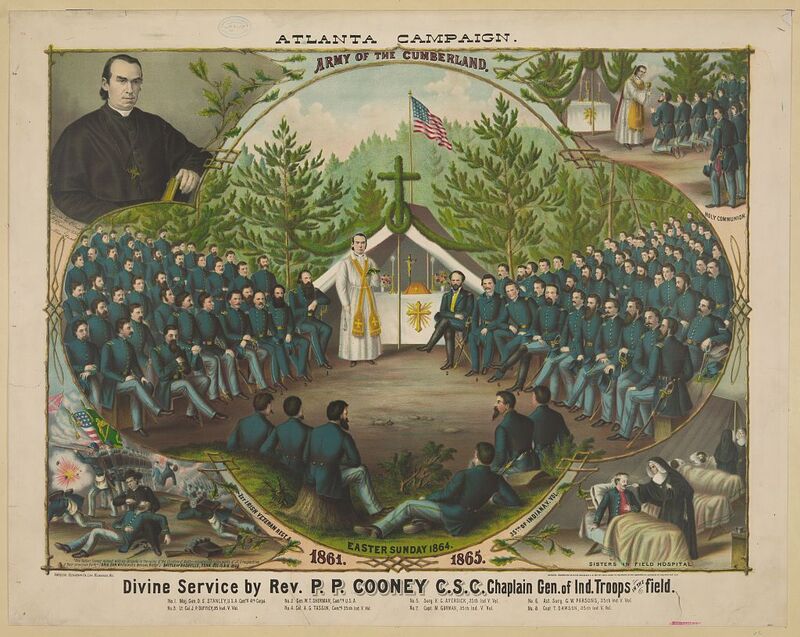
Figure 6. Civil War chromolithograph of the Fr. P. P. Cooney, the Army of the Cumberland, and the Holy Cross Sisters (Courtesy of the Library of Congress)
In the annotated image above, the Sisters of the Holy Cross are featured in the bottom right scene. Having accompanied the Army of the Cumberland on their Atlanta Campaign in 1864, a trio of Sister-Nurses is shown nursing the soldiers who lie wounded in a field hospital. Because they are pictured in the color lithograph with a Holy Cross military chaplain, Rev. P. P. Cooney, CSC, it can be deduced that the women religious are Holy Cross Sisters. Another method of identifying the sisters in the illustration is through an analysis of their habits. After reviewing the photograph of Mother Angela Gillespie on the previous page, one can see the similarities between the white headdress and silver-toned pendant she is wearing with the matching garments that are visible on the Catholic nun in the print.
Studying artwork and Civil War-themed artifacts not only aids researchers in their discovery of information about this infamous point in American history, but also contextualizes their understanding of influential figures like the Sisters of Charity, the Daughters of Charity, and the Sisters of the Holy Cross. In learning about these three communities and the other women religious who bandaged the injured and soothed the pain of their patients, we can appreciate the Christ-centered measures that they took and acknowledge their indispensable presence as Sister-Nurses.
[16] Barkley, p. 36.