For Charity's Sake
Although they are often confused as being the same order of women religious, the Sisters of Charity and the Daughters of Charity are separate communities that were not only founded by different people but also have their origins in two different countries. Interchangeably used, both during the 1860s and in modern times, they have been mistakenly associated based on the charism of charity that each Catholic congregation professes to provide. Of the two orders, the Daughters of Charity is the oldest and was founded in Paris, France by St. Vincent de Paul and St. Louise de Marillac in 1633. Intentionally referred to as Daughters instead of Sisters, the French order was created to challenge 17th-century conventions in which women religious were cloistered and did not interact with “individuals suffering in the streets”. Rather, the Daughters of Charity preferred to be with the needy and “set up soup kitchens, organized community hospitals, established schools and homes for orphaned children, offered job training, taught the young to read and write, and improved prison conditions".[2] While the Sisters of Charity, founded by St. Elizabeth Ann Seton in 1809,[3] were inspired by the Daughters of Charity and also pledged to work among the poor, they are lauded as the first American religious community and Mother Seton was canonized as the nation’s first native-born saint.
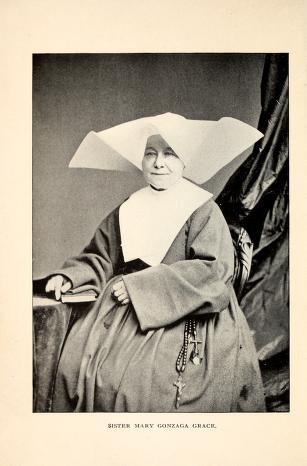
As the congregation of religious sisters who had the most representation in the Civil War, the Daughters of Charity numbered a total of 223 women, according to the Nuns of the Battlefield records. Believed to have had nursed Northern and Southern soldiers in an estimated 30 places, the Daughters of Charity in Virginia received one of the earliest requests to attend to the “Union sick” in their Norfolk hospital after a Confederate attack on April 20, 1861.[5] Likewise, in staffing Satterlee Hospital in Philadelphia, PA, under the supervision of Sister Mary Gonzaga Grace pictured in Figure 2, the Daughters of Charity were responsible for helping patients in the largest Union hospital beginning in June 1862. Touted for having 3,500 beds, Satterlee eventually housed approximately 7,000 men following the Battle of Gettysburg.[6]
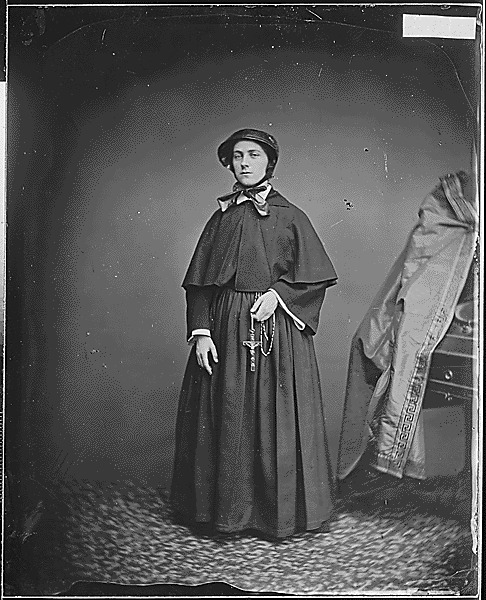
In addition to the historical differences that distinguished the Daughters of Charity from the Sisters of Charity, another striking contrast was their religious habit. When examining the photograph in Figure 3, one can see that the Sister of Charity is wearing a black bonnet, not the white cornette covering the head of the Daughter of Charity in Figure 2. A third method of determining if a religious nurse was a Sister or Daughter of Charity was in regards to her convent’s location. Whereas the Daughters of Charity were based in Emmitsburg, MD, the Sisters of Charity had formed communities in Nazareth, KY, New York City, and Cincinnati, OH. Serving in various capacities, whether in a physical ward, in makeshift hospitals, or aboard hospital ships, one of the most well-known Sisters of Charity was Sister Anthony O’Connell, Superior of the Cincinnati community. Embodying her order’s motto, she traveled between Civil War battlefields, urged by “the charity of Christ".[7]
[2] "Early History.” Daughters of Charity Province of St. Louise. https://daughtersofcharity.org/about-us/early-history/. Accessed 26 Apr. 2021.
[3] "Saint Elizabeth Ann Seton.” Sisters of Charity. https://www.srcharitycinti.org/who-we-are/archives/historical-resources/saint-elizabeth-ann-seton/who-is-elizabeth-ann-seton/. Accessed 26 Apr. 2021.
[4] Maher, Mary Denis. To Bind Up the Wounds: Catholic Sister Nurses in the U.S. Civil War. Baton Rouge, LSU Press, 1999, p. 71.
[5] Maher, p. 77.
[6] Maher, p. 112.
[7] Barkley, Elizabeth Bookser. “Jul 2013 - St. Anthony Messenger.” issuu. 14 Jul. 2016, https://issuu.com/stanthonymessenger/docs/july_digital_sam. Accessed 8 Apr. 2021, pp. 35-36.