Mourning Mothers
While the Civil War raged on, women across the United States were confronted with the possibility of widowhood when their husbands joined the Union or Confederate forces. Even though the threat of death weighed heavily on their minds, especially in the waiting for letters from their spouses, Northern and Southern women were not prepared for the devastating blow that struck them when they learned of the wartime casualties. Vinovskis[2] pointed out that the Confederacy lost more soldiers than their Union counterparts with “one out of four” men dying in battle or from disease and injury. As a result, it is likely that many of the Southern soldiers who met their demise were married and had left behind children, too.
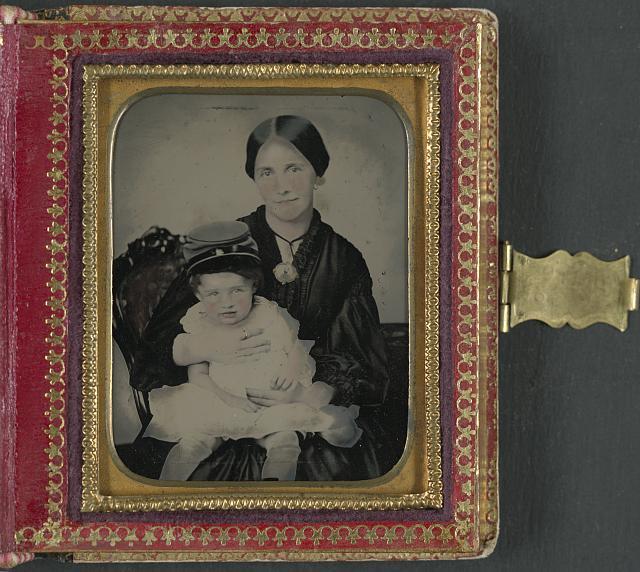
Now that these women had become widows and single mothers, the hardships they underwent were twofold, as they had to worry about feeding themselves and their families. The Confederate widows were also tasked with the dilemma of how to explain to their children that their father had been killed in action. In addition, Southern women were compelled to demonstrate their public grief through the donning of mourning dresses and the sitting for mourning portraits much like the one pictured in Figure 3.
In an undated ambrotype by photographer Charles R. Rees, the unidentified woman is believed to be the widow of a Confederate soldier, James Shields. Created between 1861 and 1865, the hand-colored portrait of this mother and son is a poignant reminder of the dreadful consequences of war. Adorned in black, the widow wears a neckline brooch with the image of her deceased husband. She also embraces a young boy with a gray kepi on his head. As the mourning brooch and military cap pay homage to the fallen Confederate soldier, the encased photograph further helps the grieving family to remember what he looked like.
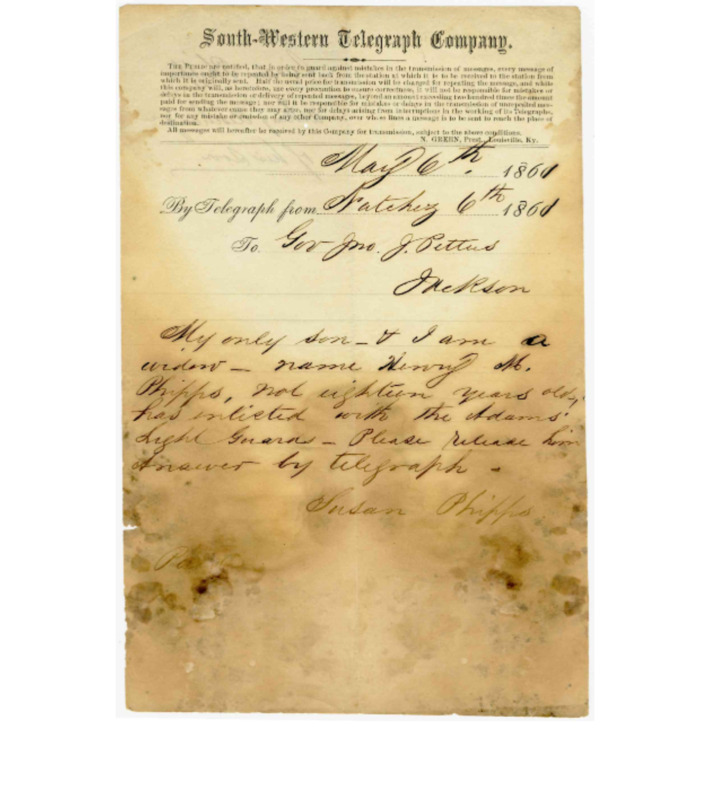
Some women, whose older sons may have followed in their father’s footsteps and volunteered for military service, had to accept the reality that they might lose their children to the Civil War as well. Rather than stand by and allow their sons to face the same fate, Mississippi widows like Mrs. Susan Phipps pleaded with authority figures such as Governor John J. Pettus to release their boys from the army. As expressed in Figure 4, Phipps sent a telegram to Gov. Pettus on May 6, 1861, begging that Henry D., her “only son”, be discharged from the 16th Infantry Regiment otherwise known as the Adams Light Guard. Mrs. Phipps also informs the governor that she is a widow and that Henry had enlisted before his eighteenth birthday. While it’s not clear if Gov. Pettus honors the widow’s request or if Henry is needed to work at home in Natchez, the dispatching of a telegram illustrates the dire straits of mourning mothers with similar stories as Phipps'.
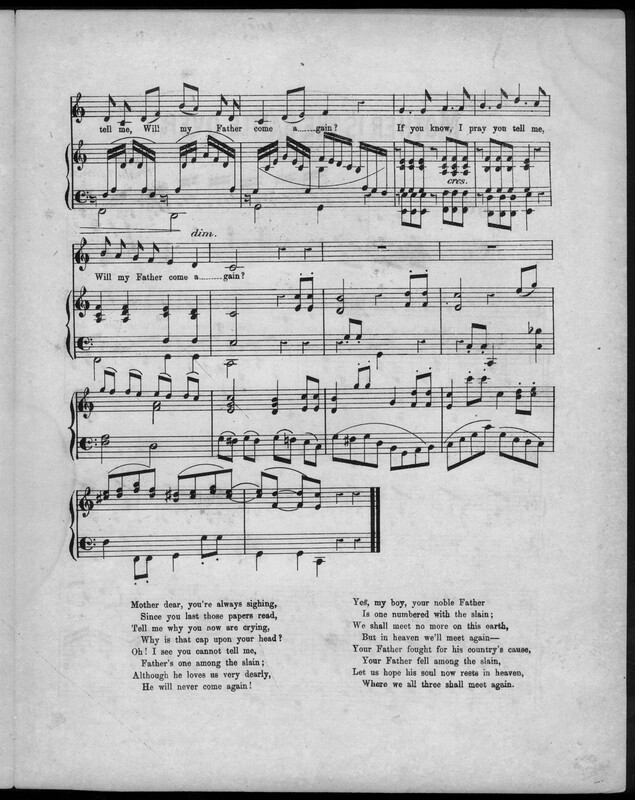
Another predicament that widows with children had to contend with was the handling of questions as to when the battle would be over and when their fathers would be returning. These queries were particularly agonizing for women to answer, as many mothers tried to spare their sons and daughters from the heartbreak of being fatherless. However, as the Confederate ballad in Figure 5 reveals, the conversation was inevitable after repeated inquiries by a child. Arranged for the piano by Jos. Hart Denck, the circa 1861-1865 notated music may be viewed as a vocal duet between a son and his mother. By page 3 of the song, the boy has noticed his mother’s tears and the mourning cap she wears, and because the pain of silence becomes too much to bear, the widow verifies that his “noble” father has sadly been slain. Without a doubt, distressing exchanges like these must have taken place all over the South, as reports of the newly dead were carried homeward.
[2] Vinovskis, Maris A. “Have Social Historians Lost the Civil War? Some Preliminary Demographic Speculations.” The Journal of American History, vol. 76, no. 1, 1989, pp. 34–58. JSTOR, www.jstor.org/stable/1908343. Accessed 10 Mar. 2021.