Conclusion
From the moment a woman became a widow, whether her husband had laid down his life on the battlefield or had lost it before the Civil War, a new set of challenges awaited her. If she also identified as a mother, a widow’s concern for her child’s well-being took precedence and gave her purpose. In spite of the sadness that widows portrayed and the mourning rituals they performed, they were obligated to carry on and do whatever they could in their role as the lone provider. Since their sons or daughters may have been too young to work, widows were responsible for the securing of food and clothing for the family. Given the demands placed upon them in keeping a roof over their children’s heads, it is not surprising that younger widows remarried or sought financial support from their state governments.
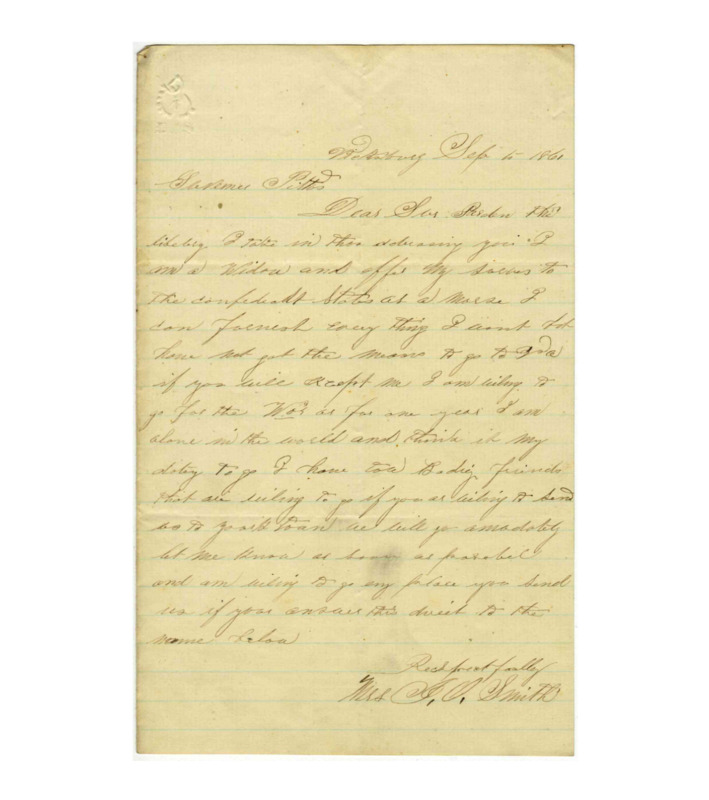
Other women who were older or childless when made aware of their dear husband’s death were presented with different choices as widows. Some ladies may have returned to the homes of their parents or siblings whereas some remained single. Based on studies by Virginia historian Kenzer,[5] “middle-aged widows. . . were more likely to own property as well as to have adult children who could provide them with aid and labor.” As a result, women in this demographic were seen as less likely to remarry, or if they did, it was to men who were “significantly younger or older.” Furthermore, if a woman was thus moved, she could also volunteer as a nurse thereby attending to the wounded and dying soldiers who had fought bravely for their country. As documented in the Figure 9 letter, Vicksburg widow, Mrs. J. O. Smith, offers her nursing services to Mississippi Governor John J. Pettus on September 5, 1861. With the governor’s permission and patronage, Mrs. Smith wishes to travel to Virginia with two female friends so that they can help care for the injured Confederate troops there. Having been widowed for a year, Mrs. Smith and her companions are inclined to “go any place” that Gov. Pettus sends them and are ready to make the trip immediately.
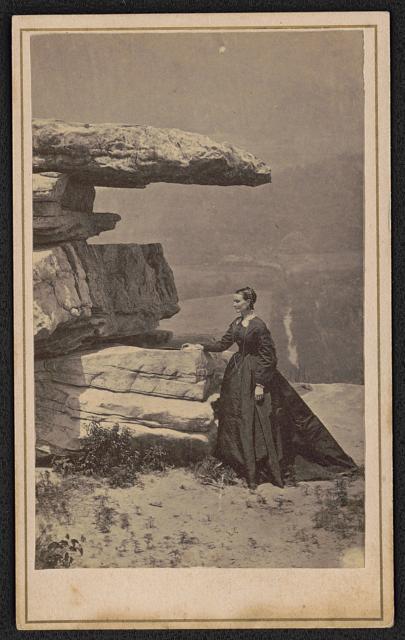
Even if a widow preferred to concentrate on the welfare of her children or on the health of patients in the midst of war, some women may have found consolation by journeying to the location where their husbands had breathed their last. And to memorialize their misery, it was popular for women to have their portraits made at the battle site as shown in Figure 10. Captured by R. M. Linn & Bro. in 1865, this cartes de visite of an unknown widow in full-mourning was photographed atop Lookout Mountain in Tennesse, where the Confederate forces experienced defeat in 1863.
However they bandaged the pangs of heartache, the widows of the Civil War were united in their shared suffering. Regardless of who they were backing, these weeping women did their part to honor the thousands of men who sacrificed their lives for the Union and Confederacy in addition to the causes for which they passionately believed and disagreed. For though the surviving women on either side had not paid the ultimate price, we can still recognize their efforts as heroines, as these valiant widows, specifically those in Mississippi, were warriors on the home front in their own right.
[5] Kenzer, Robert. "Civil War Widows.” Encyclopedia Virginia. Virginia Humanities. https://encyclopediavirginia.org/entries/civil-war-widows/. Accessed 12 Mar. 2021.