In Need of Aid
Despite the personal anguish that a widow endured, a woman with one or more child could not afford to sink into depression over the loss of her husband. As stated in Elder’s research,[3] condolence letters advised that though a woman was upset, “she must fulfill her primary duty as a mother.” And, as the sole caretaker of the family, she needed to ensure that there was food on the table and clothing for her children to wear. For many war widows who did not have the financial means to support their families, this meant relying on the generosity of relatives or seeking aid from the state in which they lived.
Since the pension system in most Southern states was not established until the late 1800s, the majority of widows had to fend for themselves when it came to providing for their children. According to the National Archives,[4] “Mississippi began granting pensions to indigent Confederate veterans or their widows” in 1888; therefore, the wives of Confederate soldiers had to wait over twenty years, long after the Civil War ended, before they could apply for assistance from the government. Instead of biding their time patiently, some Mississippi widows reacted by visiting their county courthouse, making appeals to local judges, name-dropping when necessary, and writing to their honorable governors in the hope of obtaining a bit of mercy and funds for their poor families.
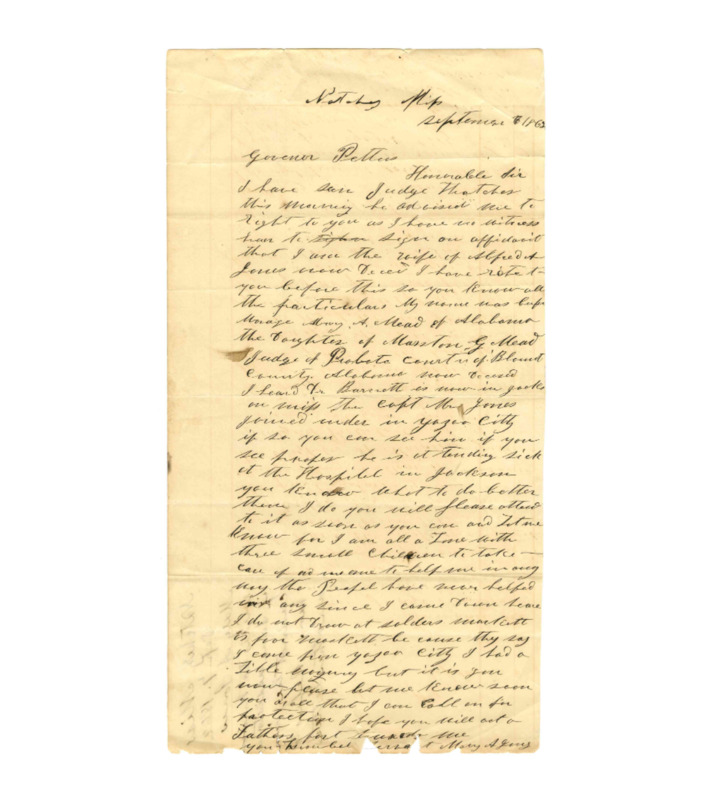
One such widow took matters into her own hands by persistently sending correspondence to Mississippi Governor John J. Pettus. As displayed in Figure 6, Mrs. Mary A. (Mead) Jones of Natchez had previously written a letter to Gov. Pettus, but when she never received a reply, she reached out a second time on September 6, 1862. So as not to be deterred, Mrs. Jones again explains her impoverished situation as she tends to three young children. Having already described her lineage as the daughter of an Alabama judge and the widowed wife of Captain Alfred A. Jones, Mrs. Jones expounds upon her family’s move from Yazoo City and exclaims how she has “no one to help me in any way.” And while she originally had a little money, Mrs. Jones beseeches Gov. Pettus to act as a father would and to give her the assistance that she desires. Whether or not her anxious petition is denied is uncertain, but in locating another letter from the Civil War & Reconstruction Governors of Mississippi collection, it seems that Mrs. Jones had made her case to Gov. Pettus in a prior request on April 16, 1862.
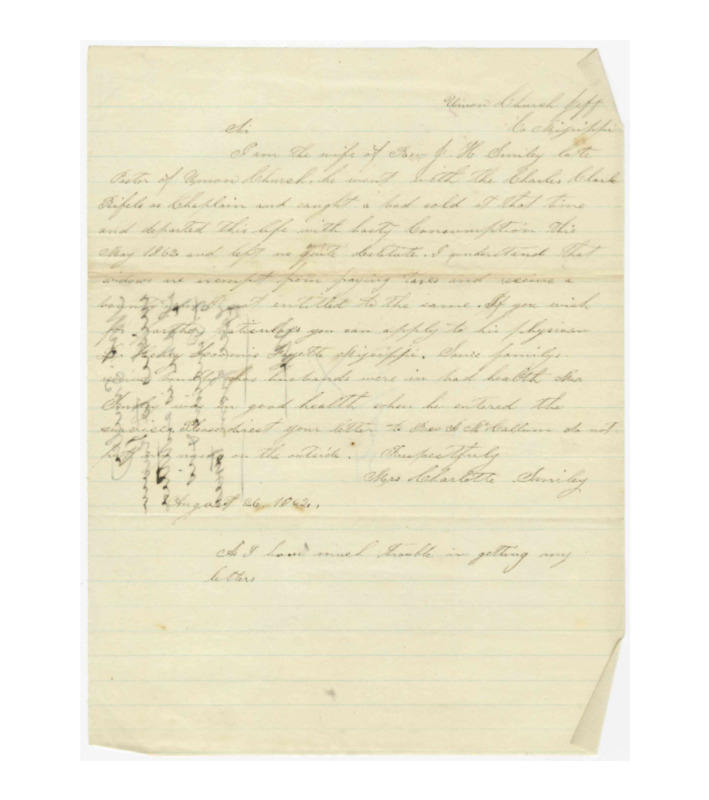
Regardless of the way in which a war widow begged her governor for help, there were unavoidable occasions when her cries were not heard. For example, in Mrs. Charlotte Smiley’s letter dated August 26, 1862, she implores Gov. Pettus to exempt her from paying taxes in Jefferson County. As observed in Figure 7, Mrs. Smiley’s late husband, the Reverend J. H. Smiley, had served as a military chaplain for the 12th Infantry Regiment, but then died from consumption. Due to his death, Smiley entreats the Mississippi governor to take pity on her “destitute” status and to let her draw a bounty as other widows are entitled to do. Although Mrs. Smiley does not directly mention children, it can be assumed that the “us” she alludes to are somehow depending on the widow. Consequently, it is difficult to not sympathize with the plight of Mrs. Smiley when Gov. Pettus’ answer is “no.”
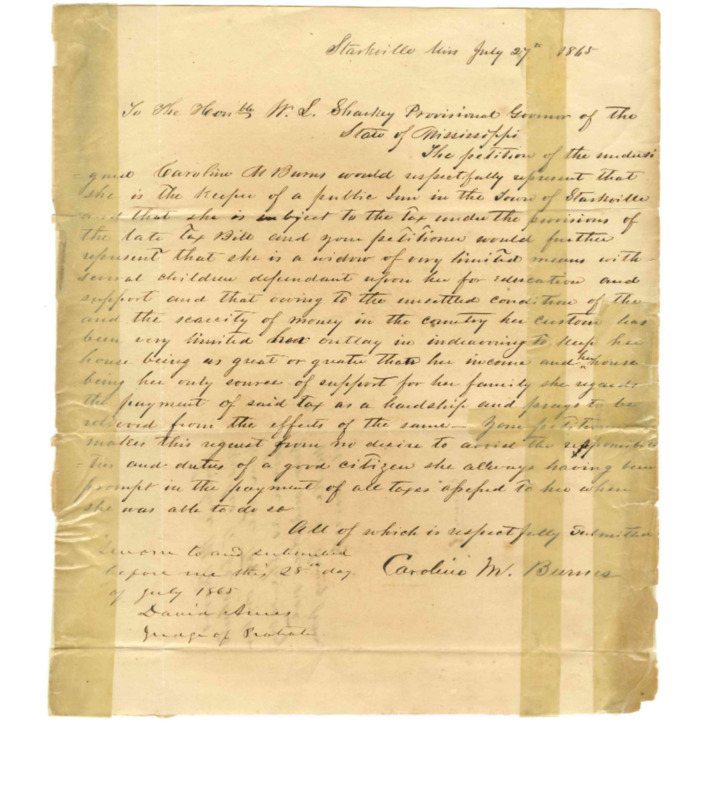
Widows who were fortunate enough to own a business in Mississippi also communicated with their elected governor and advocated for the alleviation of taxes if they struggled to pay them. As conveyed in a July 27, 1865 letter to Governor William L. Sharkey, Starkville innkeeper, Mrs. Caroline M. Burrus, has “been prompt in the payment of all taxes assessed to her.” Nonetheless, as shown in Figure 8, Judge David Ames attests that the educating of and caring for multiple children as a widow has led to a “scarcity of money” for Mrs. Burrus. Because she has a respected magistrate writing on her behalf, Mrs. Burrus is eventually relieved from the tax as she “does not make a living from” the tavern; hence, Burrus or Burns can now spend what little profit she earns on her large family.
[3] Elder, Angela Esco. "Civil War Widows.” Essential Civil War Curriculum. https://www.essentialcivilwarcurriculum.com/civil-war-widows.html. Accessed 10 Mar. 2021.
[4] "Confederate Pension Records.” National Archives. 27 Feb. 2020, https://www.archives.gov/research/military/civil-war/confederate/pension. Accessed 11 Mar. 2021.