Conclusion
After authenticating the known details about the women religious in the 1860s, one can track their movements as they left their convents and made their way to the hospitals where they nursed. For some Catholic Sisters, like the Daughters of Charity, whose convent was located in Emmitsburg, MD, they did not have to travel a great distance when 22 of their order began ministering to the wounded and dying soldiers at Satterlee Hospital on June 9, 1862.[6] Constructed in Philadelphia, PA, the Union hospital housed more than 50,000 soldiers over the course of its four-year existence due to the hospital’s proximity to the Battles of Bull Run and Gettysburg. As evident in the map below, Satterlee Hospital was an ideal location for receiving patients who were hurt on the battlefields in the Mid-Atlantic states, and the Daughters of Charity were primarily responsible for their treatment.
Other Catholic orders such as the Sisters of the Holy Cross, stationed in Notre Dame, IN, answered the call to serve by boarding the U.S.S. Red Rover, a hospital ship that transported soldiers on the Mississippi River. As annotated in Figure 9, the 1863 Harper’s Weekly engraving offered an insider’s view of the floating hospital, with two scenes of unidentified Holy Cross Sisters visiting men in the ship’s sick ward. Commended for being pioneers of the Navy's Nurse Corps, three Holy Cross Sisters made history when, on December 24, 1862, they became the first female nurses on a naval ship.[7] In addition, the trailblazing Sisters of the Holy Cross were assisted by two African American women as they cared for the wounded and recovering on the steamer.
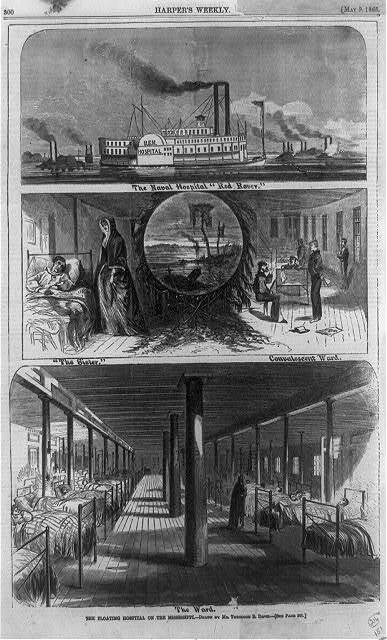
Figure 9. The floating hospital on the Mississippi, drawn by Theodore R. Davis - May 9, 1863 (Courtesy of the Library of Congress)
A third example of a community’s readiness to travel is the Sisters of Mercy, who were asked by Secretary of War Edward M. Stanton to depart New York City harbor during the summer of 1862 and voyage to Beaufort, NC on the Cahawba steamship.[8] After arriving at the Atlantic Hotel, as it was known before the building was repurposed into Hammond Hospital, the 9 Sister-Nurses commenced their care of the malnourished and neglected patients who awaited them.
But regardless of where they ministered or if they were Sisters or Daughters of Charity, to name just two types of Sister-Nurses in the Civil War, all of these brave women were willing to put their lives on the line and as inscribed on the Nuns of the Battlefield monument, “they comforted the dying, nursed the wounded, carried hope to the imprisoned, gave in His name a drink of water to the thirsty.”
[6] "Daughters of Charity Nursed Wounded Civil War Soldiers at West Philadelphia Hospital." Catholic Historical Research Center. 24 Mar. 2011, https://chrc-phila.org/sisters-of-charity-nursed-wounded-civil-war-soldiers-at-west-philadelphia-hospital/. Accessed 28 Mar. 2021.
[7] Schmidt, Jim. "Holy Cross Sisters: Navy Nurse Pioneers!” Notre Dame in the Civil War. 27 Apr. 2011, http://notredamecivilwar.blogspot.com/2011/04/holy-cross-sisters-navy-nurse-pioneers.html. Accessed 5 Apr. 2021.
[8] Herron, Mary Eulalia. “Work of the Sisters of Mercy in the United States, Diocese of New York, 1846-1921.” Records of the American Catholic Historical Society of Philadelphia, vol. 33, no. 3, 1922, pp. 216–237. JSTOR, www.jstor.org/stable/44208579. Accessed 23 Mar. 2021, p. 166.