

When contemplating a theme for my final project, I deliberated between two topics of personal interest that I could envision developing into online exhibits. The first idea I had was to create a digital walking tour of historic buildings in Downtown Mooresville. This topic is based on a self-guided map that the Mooresville Public Library published, and which I walked several years ago. Even though I would have been able to pull sufficient images of early 20th century Mooresville from the town’s archives, I did not feel as knowledgeable as to the building of a digital map to highlight these historic photographs.
My second idea, which I have ultimately selected as my project’s topic, is to explore the role of Catholic Sisters in the Civil War. Initially, I had expressed a desire to focus on the Sisters of Mercy of the Americas, an order of “nuns” who ministered to injured Union and Confederate soldiers in the Mid-Atlantic and Southeastern states. Beyond their commitment to health care, I wanted to examine the sisters’ mission to carry out works of mercy in different regions of the South through an emphasis on education and advocacy for social justice. However, after researching how the Sisters of Mercy responded to the Civil War and becoming aware of other women religious like the Daughters of Charity and the Sisters of Charity who tended to the battle-scarred in the 1860s, I decided to broaden my final theme and showcase the contributions of more Catholic nurses than I had originally proposed. And while my exhibit’s title has not changed from Angels of Mercy, I have added the subtitle of The Service of Catholic Sisters in the Civil War to pay homage to the 600-plus Sister-Nurses who eased the suffering of the sick and dying during this bloody time in American history. In fact, there was representation from a dozen communities of Catholic sisters according to a commemorative sculpture erected by the Ladies Auxiliary to the Ancient Order of Hibernians of America in 1924. The bas relief of the Nuns of the Battlefield monument shown below was sculpted by Jerome Connor and photographed by Carol M. Highsmith.
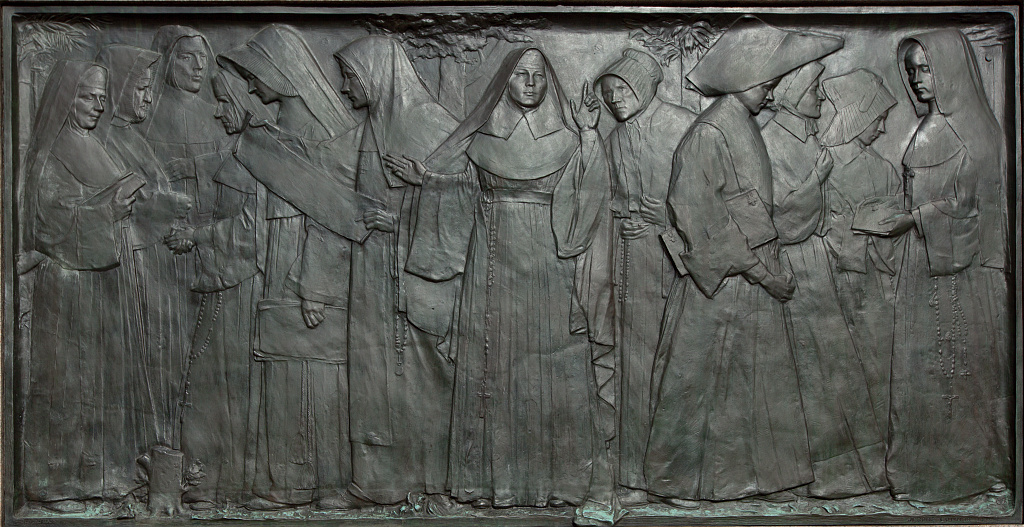
Upon learning that there were multiple religious orders who worked in Civil War hospitals and battlefields, I struggled with the decision to concentrate on the Sisters of Mercy alone even though I had found a number of items to use in my online museum. For example, I confirmed that the central figure facing front in the above historical marker bears the habit of a Sister of Mercy when referencing books and web articles about these women. Since the Sisters of Mercy were requested at military hospitals in Mississippi, North Carolina, and Washington, D.C., I planned to devote a page to each geographic location. Nevertheless, in reading accounts of the Daughters of Charity who staffed Satterlee Hospital in Philadelphia, I felt called to include a section on these sisters as well and received permission from their Provincial Archivist to use an 1865 photograph in my project. I also noticed discrepancies in the misidentification of some Civil War nuns, as either having errors in their names or being called members of the wrong order.
But regardless of whether they were Sisters or Daughters of Charity, to name just two types of Sister-Nurses in the Civil War, all of these brave women were willing to put their lives on the line and as inscribed on the Nuns of the Battlefield monument, “they comforted the dying, nursed the wounded, carried hope to the imprisoned, gave in His name a drink of water to the thirsty.”
