

I’ve long considered my aptitude for making sense of written text to be a special strength, specifically when single characters or words may appear illegible to others. However, in the crowdsourced transcribing of Civil War & Reconstruction Governors of Mississippi (CWRGM) correspondence from two male citizens to Governor John J. Pettus, I’ve come to realize that the interpretation of 19th-century communication can be a bit more complicated than I first presumed. In contrast to the ease I’ve had when, for example, translating my colleagues’ comments for students who could not comprehend their scrawled edits and suggestions on papers, there were times when scanning the Civil War letters that I understood exactly how the high schoolers felt and simply had no clue what had been jotted down.
While I’m mostly comfortable reading cursive writing after years of exchanging letters with my grandfather, it did take some adjusting to the digitized manuscripts and to the penmanship of the gentlemen who made pleas to their governor in the winter of 1862. Along with my unfamiliarity with the geography of Mississippi and the state’s history, as a whole, I also grappled with the handwriting variances and punctuation choices of the CWRGM petitioners. In particular, I had to turn off the auto-correct function in my brain that tried to capitalize sentence beginnings and insert commas or periods in place of colons and dashes.
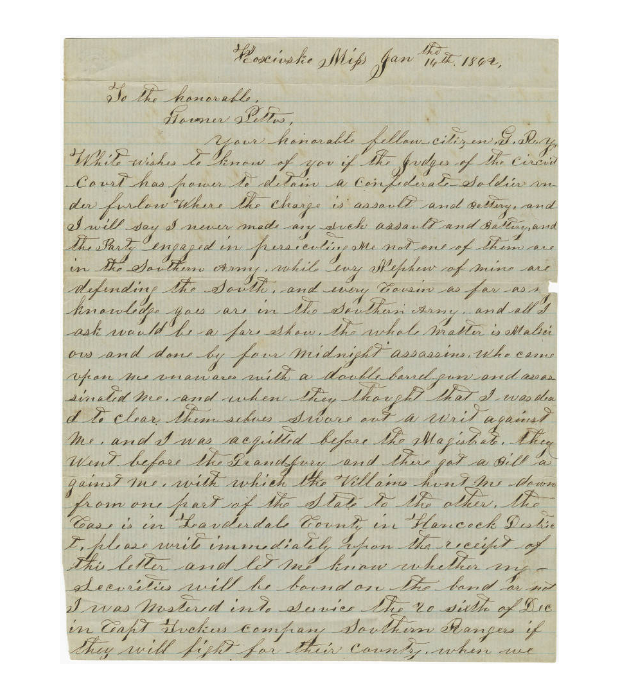
Of the two letters I was asked to transcribe, I had fewer problems with the one dated January 16, 1862 from G. R. Y. White to Gov. Pettus. Not only was the author’s writing easier to read, but it was also much more pleasing to the eye and composed upon lined paper. At one point, because the font was so clear, I even wondered whether Mr. White wrote the letter or if he had called on someone else to pen it for him. Even though little is known about the Confederate soldier, beyond his city of residence and the legal troubles he expressed in his message, I found myself curious as to how Gov. Pettus may have responded to the query about White’s “securities.” In addition, White’s letter was considerably longer and more detailed than the other letter. As White described how he was wrongfully accused of assault and battery, survived an assassination attempt, and declared guilty without a trial, I sensed the urgency of White’s entreaty to the governor in his woeful explanation of all that transpired. Furthermore, if I were creating an exhibit about similar wartime appeals in the CWRGM collection, I would search for and ideally include Gov. Pettus’ reply to G. R. Y. White on an Omeka page so that viewers could read both letters and learn the full story.
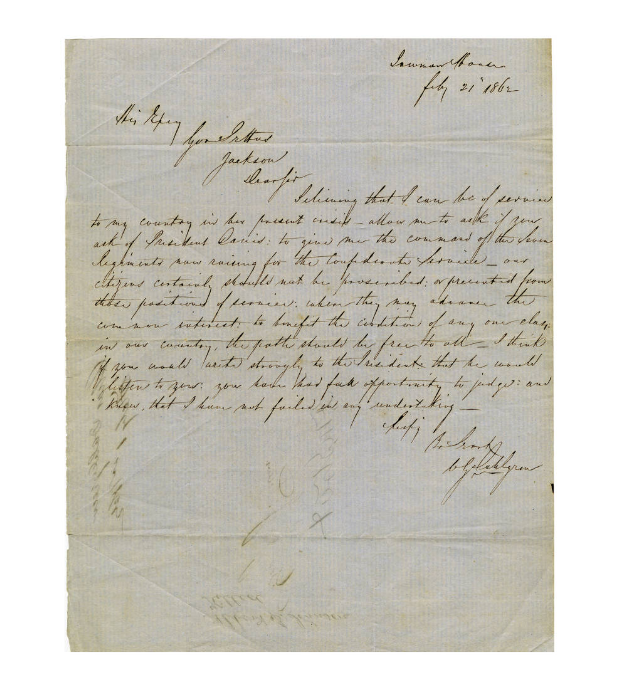
Despite the shorter length of the February 21, 1862 letter drafted by Charles G. Dahlgren to Gov. Pettus, I regarded it as the more challenging to decipher when comparing the two pieces of correspondence. Whereas General Dahlgren is a more popular historical figure than Mr. White, like White, Dahlgren beseeched Gov. Pettus to take action for him. However, in this case, it was much harder for me to decode Dahlgren’s request due to his handwriting style. Therefore, I employed more question marks in Dahlgren’s letter than anticipated, especially in reference to his location in Mississippi and in his closing salutation. I also mused about Gov. Pettus’ answer and possible intercession on behalf of Dahlgren with President Jefferson Davis. Since General Dahlgren was ultimately not granted command of the desired “Seven Regiments,” this conversation thread between the three men would make for another fascinating exhibit.
Besides following the CWRGM transcription protocols for the letters, I also annotated all five pages of text with subject tags. In doing so, I developed tags for the people, places, events, occupations, and social identifiers that were referred to in each letter. After checking the Library of Congress name authorities and subject headings, I either utilized a current subject tag or generated a new tag when applicable. One of the difficulties I encountered when assigning a current or new tag was that I questioned if the chosen name or subject qualified as an appropriate tag. I also speculated about whether I forgot to enter a subject or mistakenly tagged the wrong thing as a novice tagger.
A further issue that I experienced was in the accidental transcription of the original letter that Dr. Walters assigned me. Although the first page was left untouched, another CWRGM contributor had completed the remaining two pages of the document between the day that I created a FromThePage account and logged back in to start working on it. As a result, I was somewhat stressed during the process of transcribing the replacement letters for fear of a repeat situation and strived to finalize both transcripts within a week’s time. Nevertheless, now that the transcription project has concluded, I’m not as nervous as I once was and feel ready to tackle new letters for Dr. Ural’s project in the wake of my recent accomplishment.
