Browse Items (28 total)
Sort by:
-
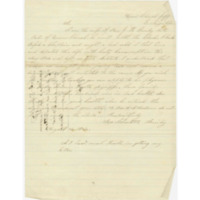
Letter from Charlotte Smiley to Mississippi Governor John J. Pettus; August 26, 1862
1862 letter from a Jefferson County, Mississippi widow, Charlotte Smiley, to Governor Pettus. Mrs. Smiley's husband, Rev. J. H. Smiley, had served as a chaplain for the Charles Clark Rifles and died in May 1862. Smiley asked if she would receive a bounty and be exempt from paying taxes as a Confederate widow. On page 2 of the letter, Smiley's pension request was denied.Tags Bounties, Chaplains, Civil War & Reconstruction Governors of Mississippi, Confederate States of America. Army, Confederate States of America. Army. Mississippi Infantry Regiment, Correspondence, Families of military personnel, Jefferson County (Miss.), Mississippi. Governor, Mississippi. Militia, Taxation, War widows, Women--1860-1870 -
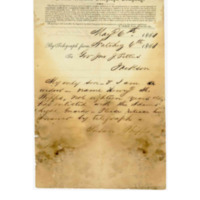
Telegram from Susan Phipps to Mississippi Governor John J. Pettus; May 6, 1861
1861 telegram from a Natchez, Mississippi widow, Susan Phipps, to Governor Pettus. Mrs. Phipps asks for her only son, Henry M. Phipps, to be released from the Adams Light Guards. Although not yet eighteen, Henry had enlisted in the 16th Infantry Regiment.Tags Civil War & Reconstruction Governors of Mississippi, Confederate States of America. Army, Confederate States of America. Army. Mississippi Infantry Regiment, Families of military personnel, Military discharge, Mississippi. Governor, Mississippi. Militia, Mothers and sons, Natchez (Miss.), Telegraph, United States--History--Civil War, Widows--1860-1870, Women--1860-1870 -
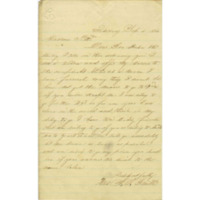
Letter from Mrs. J. O. Smith to Mississippi Governor John Jones Pettus; September 5, 1861
1861 letter from a Vicksburg, Mississippi widow, Mrs. O. J. Smith, to Governor Pettus. Mrs. Smith offers her services to the Confederate States as a nurse in Virginia. Two of her lady friends are also willing to serve in the Civil War. -
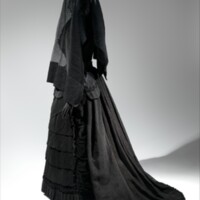
Mourning ensemble
Full-length views of a silk mourning ensemble with veil and parasol. The mannequin faces left, front, and right. The American dress features a bustle back, a train, black crinkled crepe details, and an asymmetrical ruffle. -
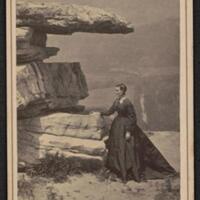
[Unidentified woman in mourning dress at Lookout Mountain, Tennessee]
Carte de visite of unknown Civil War widow. The woman is standing and facing left in a mourning dress. Her right hand is placed on a boulder atop Lookout Mountain. On the full-length portrait's verso, the photographers' name is misspelled as Lynn.
-
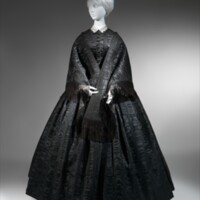
Mourning ensemble
Full-length front views of a mannequin in American mourning ensemble with matching shawl. The black moiré dress features a white lace collar and lace-trimmed cuffs. -
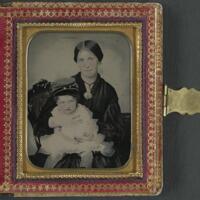
[Unidentified woman, possibly Mrs. James Shields, in mourning dress and brooch showing Confederate soldier and holding young boy wearing kepi]
Encased, hand-colored ambrotype of unknown widow and child. A dealer identified the woman in the three-quarter length portrait as Mrs. James Shields. Dressed in mourning clothes, the woman wears a brooch of a Confederate soldier and sits in a chair. The boy she holds in her lap has a kepi cap on his head. -
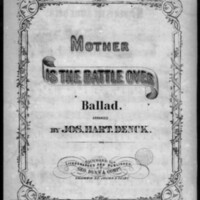
Mother is the battle over?
Civil War sheet music associated with the Confederate side. Two pages of the ballad consist of notated music and lyrics. The speaker of the song is the son of a Southern soldier. In the first two verses, the son asks his mother when or if his father is coming home. In the last verse, the widow replies and confirms that her husband is dead.Tags Library of Congress, Mothers and sons--Confederate States of America--Songs and music, Soldiers--Confederate States of America--Death--Songs and music, United States--History--Civil War, Vocal duets, War widows--Confederate States of America--Songs and music, Widows--1860-1870, Women--1860-1870