Browse Items (28 total)
Sort by:
-

Our Women and the War, from Harper’s Weekly, September 6, 1862
Print of a wood engraving published in the September 6, 1862 edition of Harper's Weekly. Attributed to Winslow Homer, the graphic art features four scenes of women interacting with Civil War soldiers. The captions "The Influence" and "Of Woman" are labeled in the top left and top right sides of the print. In the top center scene, a group of women sits in the background with two sewing shirts and one darning a sock. On the middle right side of the engraving, a woman with her back to the viewer is washing and hanging shirts while four soldiers watch. At the bottom right scene, a caption reads "Home Tidings" and a seated woman writes a letter for a bed-ridden soldier with a bandage on his head. The bottom left scene is entitled "The Sister of Charity" and shows a Daughter of Charity nurse standing beside the hospital bed of a soldier. He is holding a cross and the Catholic nun's rosary beads. In the background of this scene, another Daughter of Charity is pictured beside an injured soldier. -
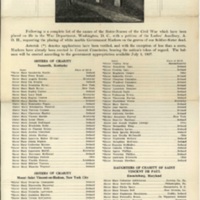
Nuns of the Battlefield, War Council Records, Box 86, Folder 61
List of 580 Civil War Sister-Nurses compiled by the War Department in Washington, D.C. At the time of the list's publication, there were 10 surviving war veterans. The 4-page document is organized into 21 communities of women religious who served on battlefields or in hospitals. Representing 11 distinct orders, the Catholic nuns are listed alphabetically, first by their specific community, then by their last name. Sister-Nurses with an asterisk by their names have had a white marble Government Marker placed at their graves at the petition of the Ladies Auxiliary to the Ancient Order of Hibernians. The list also includes a photograph of an unknown cemetery with cross headstones and Government Markers.Tags Ancient Order of Hibernians, Cemeteries, Daughters of Charity of St. Vincent de Paul, Gravestones, Nuns as nurses, Nursing--United States--History, Sisters of Charity, Sisters of Mercy, Sisters of the Holy Cross, The Catholic University of America, United States--History--Civil War, War work--Catholic Church, Women--1860-1870 -
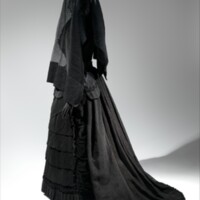
Mourning ensemble
Full-length views of a silk mourning ensemble with veil and parasol. The mannequin faces left, front, and right. The American dress features a bustle back, a train, black crinkled crepe details, and an asymmetrical ruffle. -
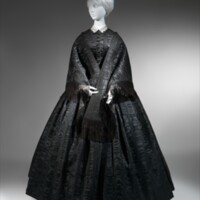
Mourning ensemble
Full-length front views of a mannequin in American mourning ensemble with matching shawl. The black moiré dress features a white lace collar and lace-trimmed cuffs. -
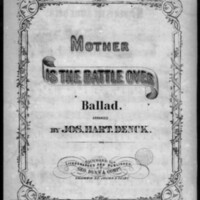
Mother is the battle over?
Civil War sheet music associated with the Confederate side. Two pages of the ballad consist of notated music and lyrics. The speaker of the song is the son of a Southern soldier. In the first two verses, the son asks his mother when or if his father is coming home. In the last verse, the widow replies and confirms that her husband is dead.Tags Library of Congress, Mothers and sons--Confederate States of America--Songs and music, Soldiers--Confederate States of America--Death--Songs and music, United States--History--Civil War, Vocal duets, War widows--Confederate States of America--Songs and music, Widows--1860-1870, Women--1860-1870 -
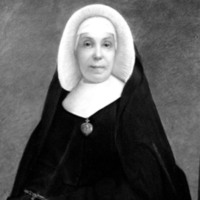
Mother Angela Gillespie
Photograph of the founder of the Holy Cross Nursing Sisters in her religious habit. Sister Angela Gillespie is wearing a white headdress and a pendant of the Sorrowful Mother also known as the Seven Dolors. The portrait is signed by Sister Bethania in the top left corner. As the supervisor of the eighty Holy Cross Sisters who served as military nurses on the U.S.S. Red Rover during the Civil War, Sister Angela Gillespie is also pictured holding her rosary beads and crucifix cross. -
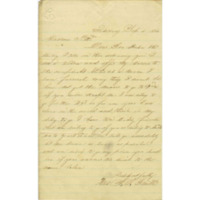
Letter from Mrs. J. O. Smith to Mississippi Governor John Jones Pettus; September 5, 1861
1861 letter from a Vicksburg, Mississippi widow, Mrs. O. J. Smith, to Governor Pettus. Mrs. Smith offers her services to the Confederate States as a nurse in Virginia. Two of her lady friends are also willing to serve in the Civil War. -
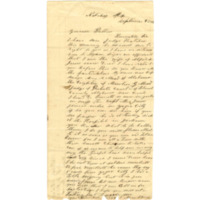
Letter from Mary A. Jones to Mississippi Governor John J. Pettus; September 6, 1862
1862 letter from a Natchez, Mississippi widow, Mary A. (Mead) Jones, to Governor Pettus. Her deceased husband, Captain Alfred A. Jones, had joined the Confederate army in Yazoo City. Mrs. Jones, who was born in Alabama, is the mother of three young children and is requesting financial assistance for her family.Tags Alabama, Children of military personnel, Civil War & Reconstruction Governors of Mississippi, Confederate States of America. Army, Correspondence, Families of military personnel, Mississippi. Governor, Natchez (Miss.), United States--History--Civil War, War widows, Women--1860-1870, Yazoo City (Miss.) -
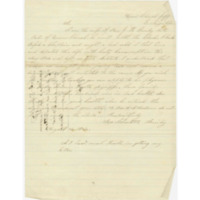
Letter from Charlotte Smiley to Mississippi Governor John J. Pettus; August 26, 1862
1862 letter from a Jefferson County, Mississippi widow, Charlotte Smiley, to Governor Pettus. Mrs. Smiley's husband, Rev. J. H. Smiley, had served as a chaplain for the Charles Clark Rifles and died in May 1862. Smiley asked if she would receive a bounty and be exempt from paying taxes as a Confederate widow. On page 2 of the letter, Smiley's pension request was denied.Tags Bounties, Chaplains, Civil War & Reconstruction Governors of Mississippi, Confederate States of America. Army, Confederate States of America. Army. Mississippi Infantry Regiment, Correspondence, Families of military personnel, Jefferson County (Miss.), Mississippi. Governor, Mississippi. Militia, Taxation, War widows, Women--1860-1870 -
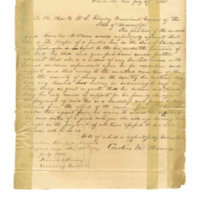
Letter from Caroline Burrus to Mississippi Governor William L. Sharkey; July 27, 1865
1865 letter on behalf of a Starkville, Mississippi widow, Caroline M. Burrus, to Governor Sharkey. Burrus or Burns appeared before Probate Judge David Ames and asked to be relieved of the tax on her inn. Ames testifies that Burrus is the poor mother of several children and the inn is her only means of support. On page 2 of the letter, Burrus' request was answered.