Browse Items (28 total)
Sort by:
-
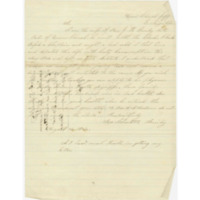
Letter from Charlotte Smiley to Mississippi Governor John J. Pettus; August 26, 1862
1862 letter from a Jefferson County, Mississippi widow, Charlotte Smiley, to Governor Pettus. Mrs. Smiley's husband, Rev. J. H. Smiley, had served as a chaplain for the Charles Clark Rifles and died in May 1862. Smiley asked if she would receive a bounty and be exempt from paying taxes as a Confederate widow. On page 2 of the letter, Smiley's pension request was denied.Tags Bounties, Chaplains, Civil War & Reconstruction Governors of Mississippi, Confederate States of America. Army, Confederate States of America. Army. Mississippi Infantry Regiment, Correspondence, Families of military personnel, Jefferson County (Miss.), Mississippi. Governor, Mississippi. Militia, Taxation, War widows, Women--1860-1870 -
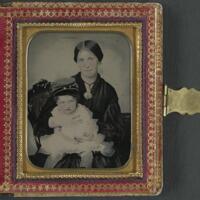
[Unidentified woman, possibly Mrs. James Shields, in mourning dress and brooch showing Confederate soldier and holding young boy wearing kepi]
Encased, hand-colored ambrotype of unknown widow and child. A dealer identified the woman in the three-quarter length portrait as Mrs. James Shields. Dressed in mourning clothes, the woman wears a brooch of a Confederate soldier and sits in a chair. The boy she holds in her lap has a kepi cap on his head. -
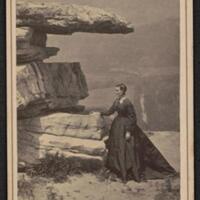
[Unidentified woman in mourning dress at Lookout Mountain, Tennessee]
Carte de visite of unknown Civil War widow. The woman is standing and facing left in a mourning dress. Her right hand is placed on a boulder atop Lookout Mountain. On the full-length portrait's verso, the photographers' name is misspelled as Lynn.
-
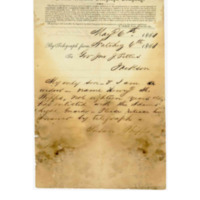
Telegram from Susan Phipps to Mississippi Governor John J. Pettus; May 6, 1861
1861 telegram from a Natchez, Mississippi widow, Susan Phipps, to Governor Pettus. Mrs. Phipps asks for her only son, Henry M. Phipps, to be released from the Adams Light Guards. Although not yet eighteen, Henry had enlisted in the 16th Infantry Regiment.Tags Civil War & Reconstruction Governors of Mississippi, Confederate States of America. Army, Confederate States of America. Army. Mississippi Infantry Regiment, Families of military personnel, Military discharge, Mississippi. Governor, Mississippi. Militia, Mothers and sons, Natchez (Miss.), Telegraph, United States--History--Civil War, Widows--1860-1870, Women--1860-1870 -
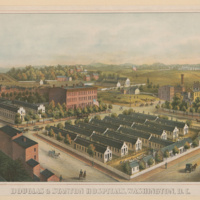
Douglas & Stanton Hospitals, Washington,D.C. / lith. & print. by Chas. Magnus, N.Y.
1864 lithograph of Douglas and Stanton Hospitals in Washington, D.C. Printed in color, the bird's eye view shows a centrally located red brick building (Douglas Hospital) across the street from a compound of white buildings (Stanton Hospital). An American flag flies atop the middlemost white building that faces Douglas Hospital. A white fence surrounds Stanton Hospital and two military guards are stationed outside of the fence. Also pictured are pedestrians on sidewalks in addition to horse-drawn carriages and men riding horses. During the Civil War, the Sisters of Mercy were requested to nurse the sick and wounded soldiers at both hospitals.Tags Bird's-eye view prints--1860-1870, Hospitals--Washington (D.C.)--1860-1870, Library of Congress, Lithographs--Color--1860-1870, Nuns as nurses, Nursing--United States--History, Sisters of Mercy, United States--District of Columbia--Washington (D.C.), United States--History--Civil War, War work--Catholic Church, Women--1860-1870 -
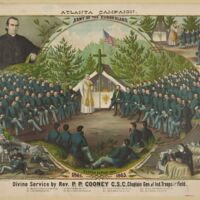
Atlanta campaign. Army of the Cumberland. Divine service by Rev. P.P. Cooney, C.S.C. Chaplain Gen. of Ind. Troops in the field
Chromolithograph of an outdoor Catholic Mass during the Atlantic Campaign of the Civil War. A portrait of Rev. P. P. Cooney, a Holy Cross Father, is pictured in the top left scene. The Union soldiers who attended the Easter Sunday field service are shown receiving holy communion in the top right scene. At the bottom left of the illustration, Fr. Cooney administers last rites to a dying soldier in a battle scene. At the bottom right of the print, a Sister of the Holy Cross dispenses medicine to a wounded soldier while two Catholic nuns face each other in the field hospital.Tags American Oleograph Co., Chromolithographs--1870-1880, Library of Congress, Military chaplains--Catholic Church, Nuns as nurses, Nursing--United States--History, Portrait prints--1870-1880, Religious services--1860-1870, Sisters of the Holy Cross, United States--History--Civil War, United States.--Army of the Cumberland--Rites & ceremonies--1860-1870, War work--Catholic Church, Women--1860-1870 -
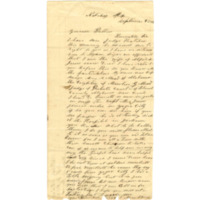
Letter from Mary A. Jones to Mississippi Governor John J. Pettus; September 6, 1862
1862 letter from a Natchez, Mississippi widow, Mary A. (Mead) Jones, to Governor Pettus. Her deceased husband, Captain Alfred A. Jones, had joined the Confederate army in Yazoo City. Mrs. Jones, who was born in Alabama, is the mother of three young children and is requesting financial assistance for her family.Tags Alabama, Children of military personnel, Civil War & Reconstruction Governors of Mississippi, Confederate States of America. Army, Correspondence, Families of military personnel, Mississippi. Governor, Natchez (Miss.), United States--History--Civil War, War widows, Women--1860-1870, Yazoo City (Miss.) -

Our Women and the War, from Harper’s Weekly, September 6, 1862
Print of a wood engraving published in the September 6, 1862 edition of Harper's Weekly. Attributed to Winslow Homer, the graphic art features four scenes of women interacting with Civil War soldiers. The captions "The Influence" and "Of Woman" are labeled in the top left and top right sides of the print. In the top center scene, a group of women sits in the background with two sewing shirts and one darning a sock. On the middle right side of the engraving, a woman with her back to the viewer is washing and hanging shirts while four soldiers watch. At the bottom right scene, a caption reads "Home Tidings" and a seated woman writes a letter for a bed-ridden soldier with a bandage on his head. The bottom left scene is entitled "The Sister of Charity" and shows a Daughter of Charity nurse standing beside the hospital bed of a soldier. He is holding a cross and the Catholic nun's rosary beads. In the background of this scene, another Daughter of Charity is pictured beside an injured soldier. -
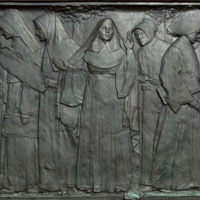
The Nuns of the Battlefield Monument, M St., NW, Washington, D.C.
Photograph of the Nuns of the Battlefield bas relief sculpted by Jerome Connor in 1924. The bronze panel is part of the monument erected by the Ladies Auxiliary to the Ancient Order of Hibernians of America. As a tribute to the Roman Catholic nuns who served as nurses in the Civil War, twelve women religious orders are represented in the sculpture.Tags Ancient Order of Hibernians, Daughters of Charity of St. Vincent de Paul, Digital photographs--Color--2000-2010, Library of Congress, Nuns as nurses, Sisters of Charity, Sisters of Mercy, Sisters of the Holy Cross, United States--District of Columbia--Washington (D.C.), United States--History--Civil War, War work--Catholic Church, Women--1860-1870 -
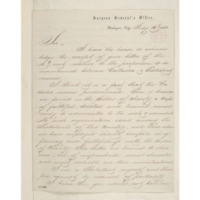
Abraham Lincoln papers: Series 1. General Correspondence. 1833-1916: William A. Hammond to Abraham Lincoln, Wednesday, July 16, 1862 (Catholic and Protestant nurses)
1862 letter from U.S. Surgeon General William A. Hammond to Abraham Lincoln. Hammond informs the President that he will try to employ more Protestant nurses but believes they do not compare to the Catholic nurses. Calling them Sisters of Charity, Hammond praises the work of the Catholic nuns in the Civil War.Tags Correspondence, Library of Congress, Manuscripts, Nuns as nurses, Nursing--United States--History, Presidents--United States, Protestants, Sisters of Charity, Surgeons general (Military personnel), United States--District of Columbia--Washington (D.C.), United States--History--Civil War, United States--Politics and government--1861-1865, Women--1860-1870