Introduction
During the American Civil War (1861-1865), the wives of soldiers who were killed in action, who died from their injuries, or who perished due to sickness were called widows. The women who bore this title lost husbands on both sides of the battlefield. Although the exact number of war widows is unknown, women in the North and South were impacted by the deaths of their spouses. Not only did the widows mourn for the men that they married, but they also grieved at the death of fathers, brothers, uncles, male cousins, and gentleman friends.
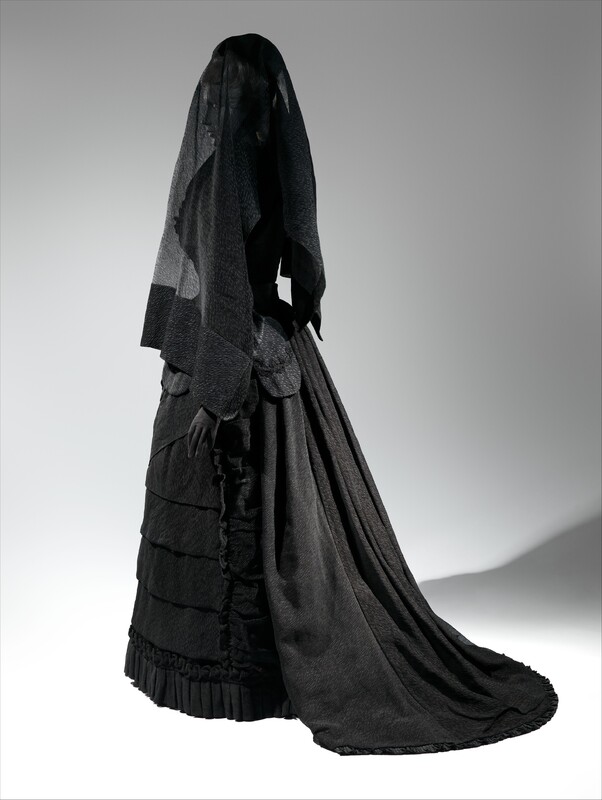
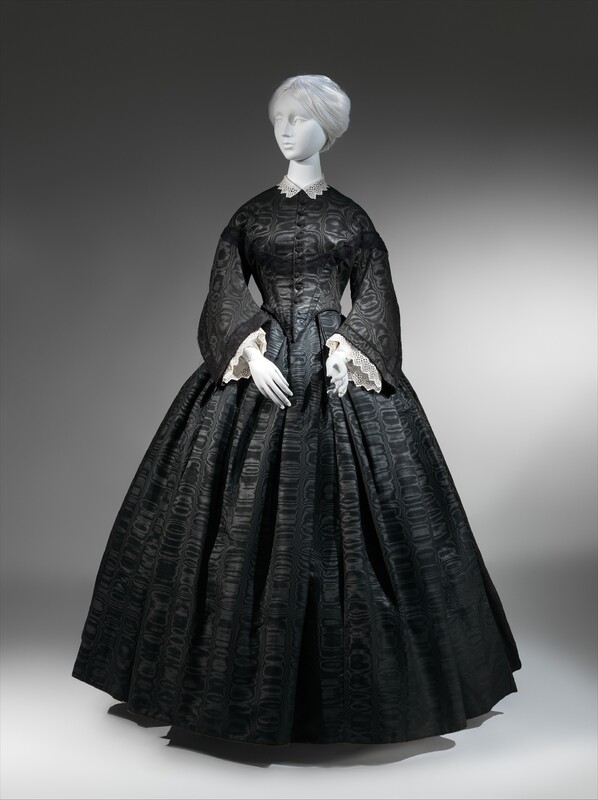
As was customary in the 19th century, widows dressed in black attire, referred to as widow’s weeds, to indicate that they were mourning the death of the man they loved. According to an Encyclopedia Virginia article,[1] widowed women who followed antebellum etiquette practices were expected to mourn for at least “two and a half years.” This period of mourning consisted of three stages: heavy, full, and half. In the heavy-mourning stage, which occurred upon the notification of a husband’s eternal rest, women wore their sorrow, and so did not dress in any other color except black. As shown in Figure 1, they also publically covered their heads with black mourning veils that were constructed out of crepe. When a grief-stricken widow entered full-mourning, she was still required to wear black clothing but was able to add a white or cream-colored lace collar and pair of cuffs to her gown, as evident in Figure 2. Once a woman reached the last stage, she had the option of wearing solid gray or purple dresses while in half-mourning.
In addition to the emotional suffering that the women in mourning experienced, some widows encountered economic struggles after losing their partners. Regardless of the circumstances in which the widows found themselves or if they were left to raise young children alone, the unfortunate passing of their husbands affected how the women responded to the news. Since most widows no longer had someone supporting them monetarily, they were forced to request governmental assistance such as tax breaks and bounties, to seek employment, to take over the running of a business, to consider remarriage after a suitable mourning time, or to ask for the discharge of sons who had enlisted in the army.
In curating the Widows of the War exhibit, an assortment of images and texts were selected from the Civil War & Reconstruction Governors of Mississippi collection, the Library of Congress, and the Metropolitan Museum of Art. Among the items included in the exhibit are four letters, two mourning dresses, notated music, two photographs, and a telegram. While the focus of the exhibit is on Confederate widows, two of the items are not from the 1860s or the American South. Nevertheless, half of the items were created by widows who resided in Jefferson County, Natchez, Starkville, or Vicksburg, Mississippi. Of the five widows who sent correspondence to their governor, four women wrote to Governor John J. Pettus in 1861 or 1862, whereas one woman contacted Governor William L. Sharkey in 1865. And so, it is the petitions of these female Mississippians which have shaped the Widows of the War exhibit.
[1] "Mourning Clothing.” Encyclopedia Virginia. Virginia Humanities. https://encyclopediavirginia.org/335hpr-fde4a920ed34106/. Accessed 7 Mar. 2021.